3D Printed Construction: 7 Ways It Is Transforming Real Estate
Discover how 3D printed construction, BIM, robotics, and generative design are transforming real estate with faster building, lower costs, and sustainable housing
3/12/20263 min read
For decades, the construction industry lagged behind the digital revolution. It was known for slow processes, high material waste, and linear workflows. While many industries improved productivity through technology, construction sites still relied heavily on manual labor and inefficient practices.
Today, this situation is changing. We are entering the era of Construction 5.0, where human expertise works together with robotic precision.
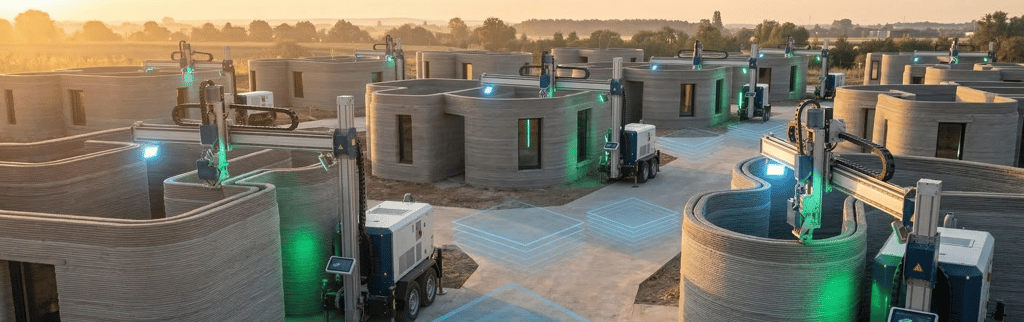
Now, a house can be 3D printed in just 24–48 hours, offering a potential solution to the global housing shortage.
This transformation is driven by 3D Constructing—the combination of additive manufacturing, generative design, and advanced Building Information Modeling (BIM). By replacing slow manual processes with integrated digital workflows, the construction industry is transforming how real estate projects are designed and delivered.
1. Algorithms Are the New Lead Architects (Generative Design)
Generative Design changes the way architects work. Instead of manually drawing every design option, architects define parameters and constraints.
In traditional workflows, designers create each design manually. With generative design, software can generate thousands of design options automatically.
Using parametric modeling, designers can set rules such as:
· Material type
· Structural load requirements
· Solar exposure
· Environmental conditions
The software then analyzes these inputs and produces many optimized design solutions.
The result is a wide design space where each option is optimized for strength, efficiency, and performance. Designers and clients can then choose the solution that best fits their goals.
2. The Infinite Material Loop: Why 3D Clay Printing Is a Sustainable Solution
While 3D concrete printing often receives the most attention, 3D clay printing may be the most environmentally sustainable approach.
This method combines ancient building materials like clay and mud with modern robotic technology.
If the clay is not kiln-fired, the material can be reused almost endlessly. A structure can even be broken down and the clay reused for new buildings.
Advantages of 3D Clay Construction
Circular sustainability
Clay is locally available and renewable, reducing transportation emissions
Thermal performance
Clay naturally provides good insulation, reducing energy use in buildings.
Non-toxic lifecycle
Clay materials are biodegradable and environmentally safe.
Aesthetic value
Clay structures offer an organic and biophilic design that many buyers value.
3. Construction Now Has a “Digital Twin” (BIM Integration)
Modern construction projects now combine BIM models with Digital Twins.
A digital twin is a real-time digital representation of a building or infrastructure asset.
Using reality capture technologies, such as 3D scanning, buildings can be scanned and converted directly into .IFC or .RVT BIM models.
This process helps ensure that the digital model matches the real-world conditions.
For example, in the HHS Angus project, this workflow achieved:
· 70% cost savings in BIM model creation
· 40 hours saved per model
Large organizations such as infrastructure utilities and manufacturing companies are already using digital twins to monitor and manage existing facilities.
This reduces site visits and minimizes costly construction errors.
4. Robotics Solving the “Rebar Bottleneck”
Rebar installation has traditionally been one of the most labor-intensive parts of construction.
To support automated construction, robotics are now being used to place reinforcement bars.
These robotic systems use deep learning and computer vision technologies to identify and place rebars accurately.
Modern systems can achieve:
· 92.5% accuracy
· Position error within 2 mm
This level of precision allows robots to handle complex reinforcement layouts that were previously difficult to automate.
As a result, automation is becoming more practical for large-scale construction projects.
5. Design Freedom Is No Longer Expensive
Traditional construction makes complex shapes expensive.
Curved walls, unique facades, and optimized structural forms require custom formwork and skilled labor.
With 3D construction, these design elements become easier and cheaper to produce.
This enables mass customization, where each building can be unique without increasing costs.
For developers, this creates an opportunity to build high-value properties with distinctive architectural features while maintaining efficient construction costs.
6. Construction Time Can Be Reduced by 50–70%
One of the biggest advantages of 3D construction is speed.
In a government housing project in Dubbo, Australia, the project timeline was reduced from 40 weeks to 20 weeks.
The structural walls themselves were printed in just 16 days.
For developers, this dramatically improves project returns.
Productivity Comparison
Traditional construction:
A builder may complete 3 houses per year.
3D construction:
One printer can produce 10 houses per year.
Multiple printers can scale production even further.
Key Environmental and Economic Benefits
· Waste reduction: up to 90%
· CO₂ emission reduction: 85.9%
· Energy consumption reduction: 87.1%
· Faster leasing: 3D-printed homes rent about 20% faster
7. Regulatory Standards Are Now in Place (ICC 1150)
One major barrier to new construction technology is regulation.
In 2025, the International Code Council (ICC) introduced ICC 1150, the first technical standard for 3D-printed concrete walls.
This standard defines requirements for:
· Safety
· Approved materials
· Structural design
In addition, ISO/ASTM 52939:2023 provides qualification standards for structural elements produced with additive manufacturing.
These standards provide the legal clarity needed for insurance companies, investors, and developers to support large-scale 3D construction projects.
Conclusion: From Experiments to Real Communities
3D construction has moved beyond experimental prototypes.
Large-scale projects like the 100-home community in Wolf Ranch, Texas show that this technology is ready for real-world development.
By combining:
· Generative design
· Sustainable materials
· BIM and digital twins
· Robotic construction
the industry now has powerful tools to address the growing demand for housing.