Artificial Intelligence in BIM: 4 Powerful Ways AI is Transforming the Construction Industry
Artificial Intelligence in BIM is transforming the AEC industry through scan-to-BIM, automated compliance checking, predictive digital twins, and smarter construction workflows
3/10/20264 min read
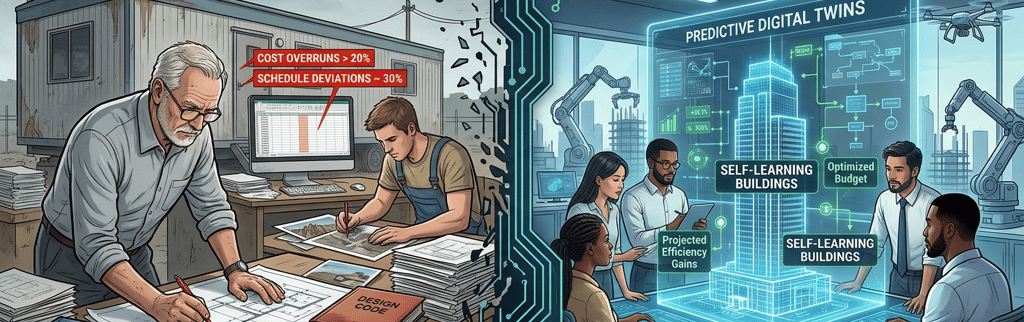
The modern construction industry presents a striking irony: we are attempting to build the future using manual, error-prone processes from a bygone era. Despite the high-tech facade of our glass-and-steel skylines, the underlying management remains shackled to a 20th-century workflow that hemorrhages capital. We rely on senior professionals to manually cross-reference design codes, human laborers to painstakingly annotate site photos, and static spreadsheets to track billions in assets. This reliance on legacy workflows carries a devastating price tag: industry data confirms that we are currently operating in a state of chronic inefficiency, with cost overruns frequently exceeding 20% and schedule deviations approaching 30%.
However, a fundamental paradigm shift is underway. We are witnessing the dismantling of the AEC (Architecture, Engineering, and Construction) industry’s most persistent bottlenecks. By bridging the gap between traditional BIM and cutting-edge computational design, we are moving toward a world of "Self-Learning Buildings" and "Predictive Digital Twins" that replace reactive reporting with autonomous, self-updating feedback loops.
1. AI is Learning to "Imagine" Buildings (Achieving Scan-to-BIM at Scale)
Teaching a machine to recognize building components used to require an army of humans to label thousands of photos—a process so labor-intensive it negated the efficiency of the AI itself. We are now bypassing this bottleneck through the use of "Synthetic Data."
Using the BIMGenE program, researchers are now parametrically and automatically generating virtual 3D models to train Artificial Neural Networks (ANNs). Instead of relying on real-world photos that are difficult to acquire and label, the machine generates its own training material. The results are staggering: an ANN trained on 660,000 computer-generated images demonstrated an 89.64% accuracy in recognizing objects on real-world building sites, even when those buildings were completely outside the range of the initial training data.
"A machine can be given a faculty akin to imagining buildings via a generative program to assist in its learning by enabling it to explore different variations of building objects and expand its learning domain."
This is the key to a "scan-to-BIM" future. This technology isn't just about labeling walls; it’s about AI-assisted semantic 3D reconstruction. By teaching machines to "imagine" variations, they can now characterize building exteriors to extract vital window-to-wall ratios and material data. This creates an immediate pathway for Building Energy Modeling (BEM) and green architecture, allowing us to document and optimize existing structures in a fraction of the time traditionally required.
2. Executable Compliance-How LLMs are Weaponizing Building Codes
Design review has long been a "senior professional" bottleneck where weeks are lost to manual cross-referencing against ambiguous regulatory texts. Previous attempts at Automated Compliance Checking (ACC) were hindered by "black box" systems and the inability to translate the legal nuances of building codes into "hard-coded rules."
The emergence of Large Language Models (LLMs)—including ChatGPT, Claude, and Gemini—is transforming ACC from a rigid, opaque system into a flexible, transparent engine. These models can now interpret complex regulatory text and convert it directly into executable Python 3.13.2 scripts for Revit 2024. This shift solves the "transparency and flexibility" issues that plagued previous tech, turning codes into live, computable scripts that verify designs in real-time.
Current AI-driven compliance engines are now catching:
Non-compliant room dimensions: Automatically flagging spaces that fail to meet minimum square footage or height requirements.
Material usage errors: Identifying the use of incorrect materials in critical fire-rated or structural zones.
Object placement violations: Catching spatial relationship errors, such as non-compliant door swings or window placements, by automatically assessing geometric relationships.
3. The Pivot from "Descriptive" to "Predictive" Digital Twins
Most Building Information Modeling (BIM) today is little more than a "digital ghost"—a static 3D model that requires manual updates and only reflects what happened yesterday. The industry is currently pivoting toward Data-Driven Digital Twins. These are not just models; they are high-fidelity "sandboxes" used for "what-if" forecasting and resource optimization.
Feature - Traditional BIM - AI-Enabled Digital Twin
Data Flow - Static; manual updates. - Live: Real-time synchronization.
Framework - Fragmented data silos .- Unified: Integrated 4D/5D knowledge graphs.
Analysis - Reactive; shows history. - Predictive: Computer Vision (CV) tracking.
Decision Support - Human-Intuition Dependent.- DRL-Optimized: Deep Reinforcement Learning.
This evolution delivers what we call "Control Resilience." By utilizing Bayesian probabilistic scheduling, these twins update activity-duration posteriors based on field evidence from LiDAR and photogrammetry. This allows project managers to see a delay coming weeks before it manifests, running simulations on Deep Reinforcement Learning (DRL) agents to reallocate crews or equipment before capital is lost to downtime.
4. The 43.4% Efficiency Leap: The Dallas-Fort Worth Proof of Concept
These advancements have moved beyond academic theory and into the field. A nine-month case study on a mid-rise project in the Dallas-Fort Worth (DFW) region provided empirical proof of this computational shift. By fusing NLP cost mapping with a 4D/5D digital twin framework, the project achieved gains that represent a fundamental realignment of construction economics:
43.4% reduction in estimating labor: Driven by the automated NLP-based mapping of specifications directly to CSI divisions.
6% reduction in total overtime: Achieved via DRL agents that optimized resource allocation under real-time constraints.
Probabilistic Reliability: The project maintained an on-time finish at 128 days, staying strictly within P50-P80 confidence bounds despite typical site volatility.
Buffer Management: The system maintained a 30% project-buffer utilization, providing a level of "Control Resilience" previously impossible under deterministic scheduling.
This isn't just about speed; it's about accuracy. When a system can automatically extract window-to-wall ratios and material types from a scan, it generates a 5D knowledge graph that is traceable, auditable, and ready for Building Energy Modeling (BEM).
Conclusion: From Reactive Reporting to Predictive Power
The AEC industry is undergoing a metamorphosis, shifting from a manual process governed by human intuition to an autonomous, evidence-driven feedback loop. We are entering an era where the digital model is no longer a static blueprint, but a living entity that monitors, predicts, and optimizes its own creation.
As we establish this "pathway toward predictive, adaptive, and auditable construction management," we must confront a vital question: If a machine can now "imagine" a building's mistakes before the first brick is laid, what happens to the role of the traditional architect? The answer lies in the shift from manual drafting to high-level strategic oversight, where the human architect directs the AI’s "imagination" to build with a level of computational resilience the industry has never seen.