Multi-Dimensional BIM: 6 Key Lessons Beyond the Blueprint
Learn how Multi-Dimensional BIM transforms construction through 4D, 5D, 7D, and 8D insights, improving project coordination, ROI, and lifecycle
3/10/20263 min read
The construction industry is evolving rapidly. Moving from traditional 2D drawings and 3D CAD workflows to data-driven BIM environments is no longer optional—it has become essential for successful project delivery.
For project owners, consultants, and contractors, relying only on simple drawings often leads to project delays, cost overruns, and site rework. These issues usually arise when project information is fragmented and coordination between disciplines is weak.
Building Information Modeling (BIM) provides a solution. BIM is not just a software tool; it is a shared digital representation of a building or infrastructure asset that supports better decision-making throughout the entire project lifecycle.
By integrating additional layers of information—such as time, cost, safety, and sustainability—BIM transforms a static 3D model into a powerful decision-making platform that improves planning, coordination, and overall project value.
1. The Hidden Mathematics Behind Modular Construction (DfMA)
In modular construction, success depends heavily on Design for Manufacture and Assembly (DfMA). This approach focuses on designing building components so they can be efficiently manufactured off-site and assembled on-site.
Instead of designing isolated components, project teams develop standardized spatial modules that can be reused across multiple projects.
The goal is mass customization—delivering unique architectural outcomes while using standardized components.
When dimensions and proportions are properly coordinated during the design phase, modules can be reused effectively. However, if this coordination is neglected, projects often face transport challenges, installation delays, and on-site construction conflicts.
As highlighted in the Wong Chuk Hang (WCH) modular construction case study:
“Achieving mass customization in modular construction requires careful attention to dimensions and proportional relationships during design development.”
2. Understanding the Real Return on Investment (ROI) of BIM
Many organizations evaluate BIM primarily through direct cost savings from reduced rework, commonly referred to as Primary ROI.
However, BIM delivers far greater value when considering its integrated benefits, including improved collaboration, better project monitoring, and enhanced lifecycle management.
Research from projects in Seoul and Hong Kong highlights the difference clearly:
Primary BIM ROI (Reduced Rework): 167.8%
Integrated BIM ROI (Total Project Impact): 476.72%
This demonstrates that the true value of BIM lies not only in preventing errors but also in improving communication, reducing information gaps, and enabling more efficient project management across the entire construction lifecycle.
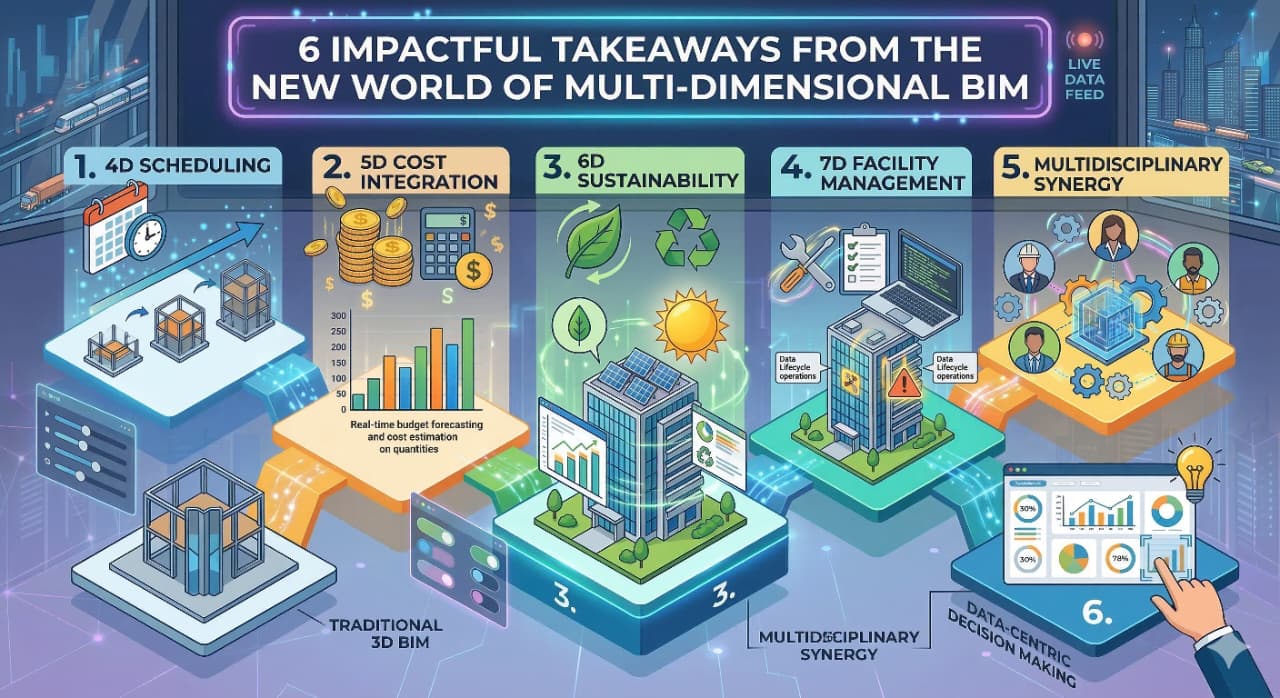
3. 4D and 5D BIM: Managing Time and Cost
4D BIM introduces the time dimension to the BIM model, allowing teams to simulate construction schedules digitally.
Using tools such as Navisworks and Synchro, project teams can test different construction sequences and identify the most efficient workflow before construction begins.
5D BIM adds cost data to the model, enabling better financial control throughout the project.
Together, 4D and 5D BIM allow project teams to:
Track planned vs. actual construction progress
Monitor schedule delays
Understand real-time cost impacts
This transforms the BIM model into a live project dashboard, supporting proactive decision-making.
4. 7D BIM: Extending Value into Facility Management
The value of BIM should not end once construction is completed.
7D BIM focuses on facility management and operational performance after project delivery.
One of the biggest challenges in traditional construction projects is information loss during the handover from contractor to building owner. This often leads to inefficiencies in building maintenance.
The COBie (Construction Operations Building Information Exchange) standard helps solve this issue by structuring essential asset information, including:
Equipment manuals
Warranty information
Maintenance schedules
This structured data forms the Asset Information Model (AIM), which supports the development of a Digital Twin of the building.
Facility managers can use this digital model to plan maintenance activities, monitor performance, and optimize building operations over time.
8D BIM: A New Approach to Construction Safety
8D BIM introduces safety considerations directly into the design and planning process.
Traditionally, safety management is reactive and focused mainly on site activities. However, 8D BIM promotes Prevention through Design (PtD), identifying risks before construction begins.
Through hazard analysis and safety reviews during the design stage, potential risks can be minimized early in the project.
When combined with technologies such as Virtual Reality (VR) and a well-defined Building Execution Plan (BEP), 8D BIM enables project teams to:
Identify hazards earlier
Improve safety training
Reduce accidents and safety risks
Ultimately, this approach protects the most valuable asset in any construction project—the workforce.
6. Digital Maturity Is About Collaboration, Not Software
According to ISO 19650, digital maturity in construction is not determined by which software is used. Instead, it depends on how effectively teams collaborate and manage information.
The industry generally recognizes two key stages of BIM maturity:
Stage 2
Information is exchanged through separate files between disciplines. This often leads to data silos and coordination challenges.
Stage 3
Projects operate in a fully integrated, cloud-based collaborative environment. Teams can access updated information in real time, improving transparency and coordination.
At this level, the Digital Twin becomes a living data environment that continues to provide value throughout the building lifecycle.
Conclusion: Building a Stronger Foundation for Decisions
As digital transformation continues to reshape the construction industry, multi-dimensional BIM is becoming the foundation of modern project delivery.
By integrating time, cost, safety, and operational data, BIM goes far beyond traditional 3D modeling. It enables smarter decisions, reduces waste, and enhances the long-term value of built assets.
In an industry where the integrated return on investment from BIM can reach 476%, one important question remains:
Can we still afford to design in only three dimensions?