
History of Landscape Architecture: 4,000 Years of Design
Discover the 4,000-year history of landscape architecture, from ancient Persian and Egyptian gardens to modern BIM, GIS, and sustainable landscape design.
Asterwix
7/18/20264 min read

Ancient Beginnings: Gardens as Paradise
The earliest known designed landscapes emerged in Mesopotamia and Egypt, roughly 4,000 years ago. Egyptian tomb paintings depict walled gardens with symmetrical pools, shade trees, and vineyards — spaces designed for both the living and the dead, reflecting a worldview where order in nature mirrored order in the cosmos.
In Mesopotamia, the legendary Hanging Gardens of Babylon, whether myth or history, captured an idea that would echo for millennia: that a garden could be an act of engineering as much as beauty, using terraces and irrigation to defy the surrounding desert.
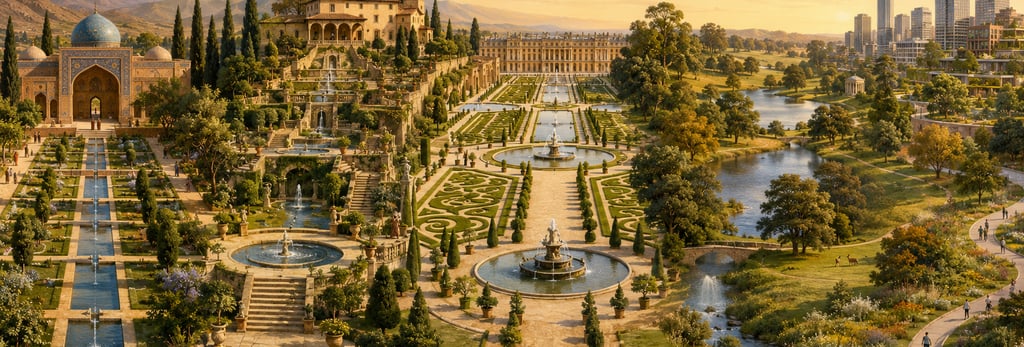
The Persians formalized this idea into the chahar bagh — the four-part garden divided by water channels representing the rivers of paradise. This model, born around the 6th century BCE, would travel through Islamic civilization all the way to Mughal India, shaping gardens for the next 2,000 years.
Classical Order: Greece and Rome
The Greeks brought landscape design into civic and philosophical life. Sacred groves, gymnasiums, and the agora integrated planted space into public gathering, while sanctuaries like Delphi used the natural terrain itself as part of the architectural composition — an early recognition that landscape and building were not separate disciplines.
Rome scaled this up dramatically. Wealthy Romans built villas with elaborate garden rooms, clipped hedges (topiary), fountains, and sculpture galleries — a fusion of horticulture and architecture that historians now call the first true "landscape architecture" in the Western sense. Pliny the Younger's writings about his own villa gardens remain some of the earliest detailed design descriptions we have.
The Islamic Garden and Its Global Reach
Following the Persian chahar bagh tradition, Islamic civilization produced some of history's most refined garden design, from the Alhambra in Spain to the gardens of Isfahan in Iran. Water was the organizing principle — not just for irrigation, but as a symbolic and sensory element, reflecting light, cooling air, and providing the sound of movement in otherwise still courtyards.
This tradition reached its zenith in Mughal India with gardens like Shalimar Bagh and the garden setting of the Taj Mahal, where architecture, water, and planting were conceived as a single, unified composition — a principle still foundational to landscape design today.
Renaissance Italy and the Geometry of Power
In 15th- and 16th-century Italy, landscape design became a deliberate expression of humanist ideals and aristocratic power. Villas like the Villa d'Este at Tivoli used terraces, axial symmetry, and dramatic water features to choreograph a visitor's movement through the landscape — treating the garden as a spatial narrative rather than a static backdrop.
The French Formal Garden
This Italian influence crossed the Alps and, under designers like André Le Nôtre, became something even grander in France. Le Nôtre's masterwork, the gardens of Versailles, turned landscape into an instrument of absolute monarchy: endless axial vistas, geometric parterres, and controlled sightlines that made nature itself appear subject to royal will. It remains one of the most influential works in the history of the profession.
The English Landscape Movement
By the 18th century, a reaction set in. Designers like William Kent, Capability Brown, and later Humphry Repton rejected rigid French geometry in favor of the "natural" landscape — rolling lawns, serpentine lakes, and carefully placed clumps of trees designed to look as though nature had arranged them herself. It was, paradoxically, some of the most heavily engineered land in Europe, made to appear untouched. This movement fundamentally changed how the West thought about the relationship between design and nature.
The Birth of a Profession: Olmsted and the Public Landscape
The modern profession of landscape architecture was effectively founded in 19th-century America by Frederick Law Olmsted, who coined the term itself. His design for Central Park in New York (with Calvert Vaux) established landscape architecture as a discipline concerned with public health, democratic access to nature, and urban planning at a civic scale — not just private estates.
Olmsted's influence spread through America's park systems, campus designs, and the emerging "City Beautiful" movement, professionalizing a field that had, until then, been the domain of gardeners, architects, and gentleman-amateurs.
Modernism and the 20th Century
The 20th century brought new materials, new social priorities, and new aesthetic movements. Designers like Roberto Burle Marx in Brazil brought abstract, biomorphic forms and native planting into landscape design, while figures like Thomas Church, Garrett Eckbo, and Dan Kiley in the United States developed a modernist landscape vocabulary suited to postwar suburban and corporate life — clean lines, functional zoning, and integration with modern architecture.
Meanwhile, landscape architecture increasingly engaged with ecology, environmental science, and infrastructure — a shift crystallized by Ian McHarg's 1969 book Design with Nature, which argued that landscape planning should be grounded in ecological analysis, not just aesthetics.
Contemporary Practice: Landscape as Infrastructure
Today, landscape architecture sits at the intersection of ecology, urbanism, climate resilience, and technology. Projects like New York's High Line have shown how post-industrial landscapes can be reimagined as public space, while cities worldwide increasingly use landscape design for stormwater management, urban cooling, and biodiversity, not just beauty.
Digital tools — GIS, parametric design, and BIM (Building Information Modeling) — have transformed how landscape architects plan and coordinate complex projects, allowing planting, grading, drainage, and hardscape to be modeled and coordinated with the same precision as architectural and structural systems. In fast-growing regions like the GCC, where large-scale masterplanning and extreme climate conditions demand tight coordination between disciplines, this shift toward digital, standards-based landscape design (such as ISO 19650 workflows) has become central to delivering ambitious public and private landscapes.
A Continuous Thread
From the shaded courtyards of Persia to the terraces of Renaissance Italy, from Olmsted's public parks to today's climate-responsive urban landscapes, one thread runs through the entire history of the discipline: landscape architecture has always been about shaping the relationship between people and the natural world — sometimes to control it, sometimes to celebrate it, and increasingly, to heal it.