
Why Does Humanity Make Landscapes? A Journey Through History
Why does humanity make landscapes? Explore the history, purpose, and evolution of landscape architecture from ancient gardens to modern sustainable design.
Asterwix
7/16/20262 min read
Why Does Humanity Make Landscapes?
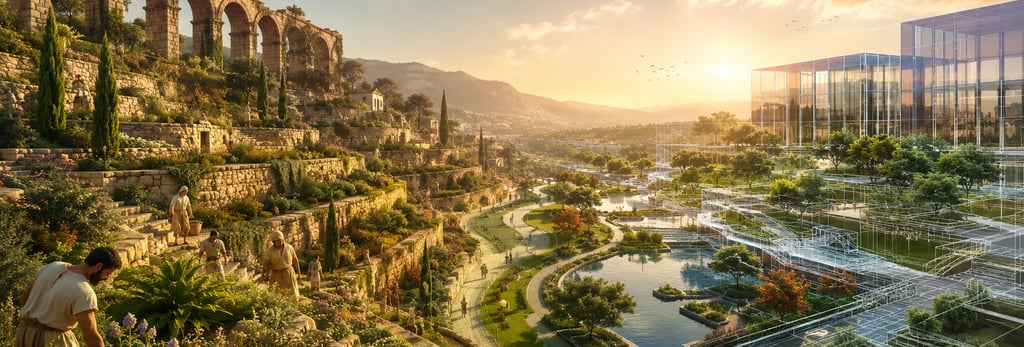
Long before the first brick was laid or the first wall raised, humans were already shaping the ground beneath their feet. We terraced hillsides for rice. We diverted rivers into gardens. We planted trees in patterns that meant something — to the eye, to the gods, to memory. Landscape-making is one of the oldest acts of civilization, and it has never really stopped. The question is: why?
1. To Tame the Wild — and Stay Connected to It
At its root, landscaping is a negotiation between control and wilderness. Early humans cleared land to farm and survive, but very quickly that necessity turned into something more — an aesthetic, even spiritual, relationship with the earth. The Persian paradeisos (walled gardens), the Japanese karesansui (dry rock gardens), the sprawling lawns of English estates — each reflects a culture's answer to the same impulse: nature is beautiful, but we want it arranged.
Landscapes let us keep nature close without surrendering to it entirely.
2. To Mark Identity and Power
Look at any palace, temple, or grand estate throughout history, and you'll find a designed landscape beside it. Versailles wasn't just a garden — it was a political statement, a display of order and dominance over nature itself. Mughal gardens symbolized paradise on earth. Even today, a corporate headquarters with a manicured plaza or a residential community with themed green spaces is communicating something: status, taste, permanence.
Landscapes are identity made visible.
3. To Heal
There's a growing body of evidence — and an even older body of instinct — that green spaces restore us. Hospitals with gardens report faster patient recovery. Office parks with water features report lower stress. Cities that invest in parks see measurable improvements in mental health and community cohesion. We don't just enjoy landscapes; we need them, biologically and psychologically. This is sometimes called biophilia — humanity's innate pull toward living systems.
4. To Build Community
A well-designed public landscape — a plaza, a waterfront promenade, a neighborhood park — becomes a stage for human life. People meet, children play, elders gather. Landscape architecture, done well, isn't decoration around a building; it's the connective tissue of a community. It shapes how people move, linger, and interact.
5. To Leave Something Behind
Perhaps the deepest reason is the simplest: landscapes outlive us. A building might be demolished and rebuilt in decades, but a well-planned grove of trees, a terraced garden, or a shaped waterway can persist for generations, maturing and improving with time. To design a landscape is to plant something for people you will never meet.
The Modern Landscape: Precision Meets Purpose
Today, this ancient impulse meets modern technology. Landscape design has evolved from sketches and intuition into precise, coordinated, data-driven processes — Landscape BIM (Building Information Modeling), for instance, allows every tree, grade, drainage line, and hardscape element to be modeled, coordinated, and verified before a single shovel touches the ground. It's the same human instinct — shaping the earth with intention — expressed through 21st-century tools.
Whether it's a public park, a residential community, or a large-scale master plan, the "why" hasn't changed much since the first terraced hillside. We make landscapes because we long to belong to the earth we shape — beautifully, deliberately, and on purpose.
What draws you to landscape design — the artistry, the technology, or the impact on communities? The reasons we build have shaped every garden, park, and public space in history — and they're still shaping the ones being designed today.